
Part 3. Validating Tibero7 on Nutanix AHV: Operational Testing and Nutanix Ready Validation Results


Introduction
In Part 1: Tibero7 Compatibility Validation and Architecture Analysis on Nutanix AHV-based HCI, we explored the key characteristics of the Nutanix HCI platform, the background behind Tibero7 achieving Nutanix Ready Validation, and the stability and compatibility that Tibero7 delivers when deployed on Nutanix AHV.
In Part 2: Deploying Tibero7 TAC on Nutanix HCI, we introduced the validation environment and deployment architecture for both Single Instance and Tibero Active Cluster (TAC) configurations. We also walked through the complete deployment workflow, from virtual machine provisioning and shared storage configuration to building a TAC environment using Tibero Active Storage (TAS).
In this final installment, we focus on the operational validation performed after the deployment was completed.
The article examines the key validation scenarios required for the Nutanix Ready Validation program, including online resource scaling, virtual machine migration, VM cloning, and VM snapshots. These tests demonstrate how Tibero7 behaves during common infrastructure operations and confirm its operational stability in a Nutanix AHV-based HCI environment.
For infrastructure architects and database administrators evaluating Nutanix as a database platform, this validation provides practical evidence of Tibero7’s compatibility and operational reliability. It also expands the range of supported deployment options beyond traditional VMware-based virtualization environments to include Nutanix AHV-powered HCI platforms.
9. Tibero Active Cluster Deployment and Nutanix Ready Validation
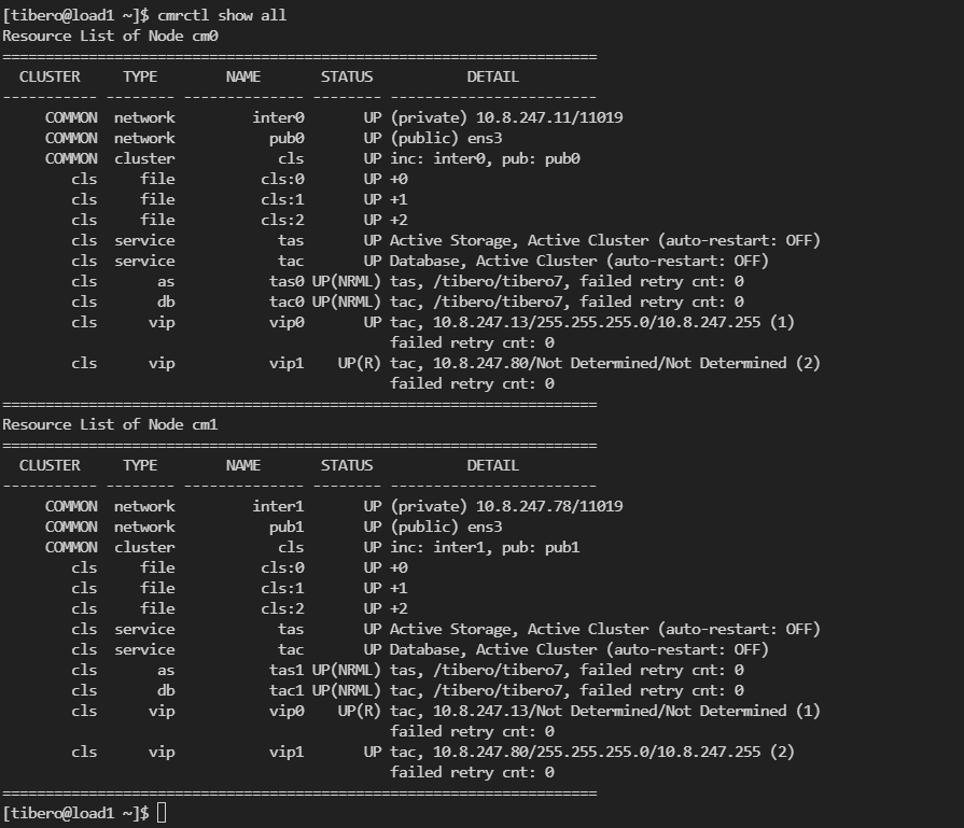
Once the infrastructure had been fully prepared, Tibero Active Cluster (TAC) was deployed using the same procedures employed for a conventional two-node on-premises TAS-TAC environment.
The deployment completed successfully without requiring any Nutanix-specific modifications to the standard TAC installation process.
Nutanix Ready Validation Scope
The Nutanix Ready Validation for Tibero7 evaluated several operational scenarios designed to verify that the database remains stable during routine virtualization and infrastructure management tasks.
Because Tibero6 had previously completed the same certification program, the validation for Tibero7 was conducted through a streamlined process in collaboration with the Nutanix Ready APAC Team.
The primary validation scenarios included:
- Online virtual machine resource scaling
- Memory
- CPU
- Network interface (NIC)
- Virtual disks
- Virtual machine migration between Nutanix clusters
- Virtual machine cloning
- Virtual machine snapshot operations
These validation scenarios were performed using the Single Instance deployment of Tibero7.
Validation Objectives
The purpose of these tests was to verify that Tibero7 continues operating normally while infrastructure changes are performed online, without requiring the database instance to be shut down.
All validation scenarios were executed while the virtual machine and database remained online.
This approach reflects real-world enterprise operations, where infrastructure administrators frequently perform maintenance tasks—such as increasing virtual resources, migrating workloads, or creating snapshots—without interrupting database services.
The following sections provide representative examples of each validation scenario.
Why These Tests Matter
One of the primary advantages of virtualization is the ability to modify infrastructure resources dynamically with minimal or no service interruption.
For enterprise database platforms, however, maintaining service continuity during these operations is equally important.
The Nutanix Ready Validation therefore focused not only on whether the virtualization features functioned correctly, but also on whether Tibero7 maintained operational stability throughout each online infrastructure event.
Successful completion of these tests demonstrates that Tibero7 can coexist seamlessly with Nutanix AHV’s virtualization capabilities, enabling administrators to perform common operational tasks while maintaining database availability.
9.1 Online Virtual Machine Resource Scaling
One of the key validation scenarios was verifying that Tibero7 remains fully operational while virtual machine resources are expanded dynamically.
All resource modifications were performed online, without shutting down either the virtual machine or the database instance.
The following resource expansion scenarios were successfully validated.
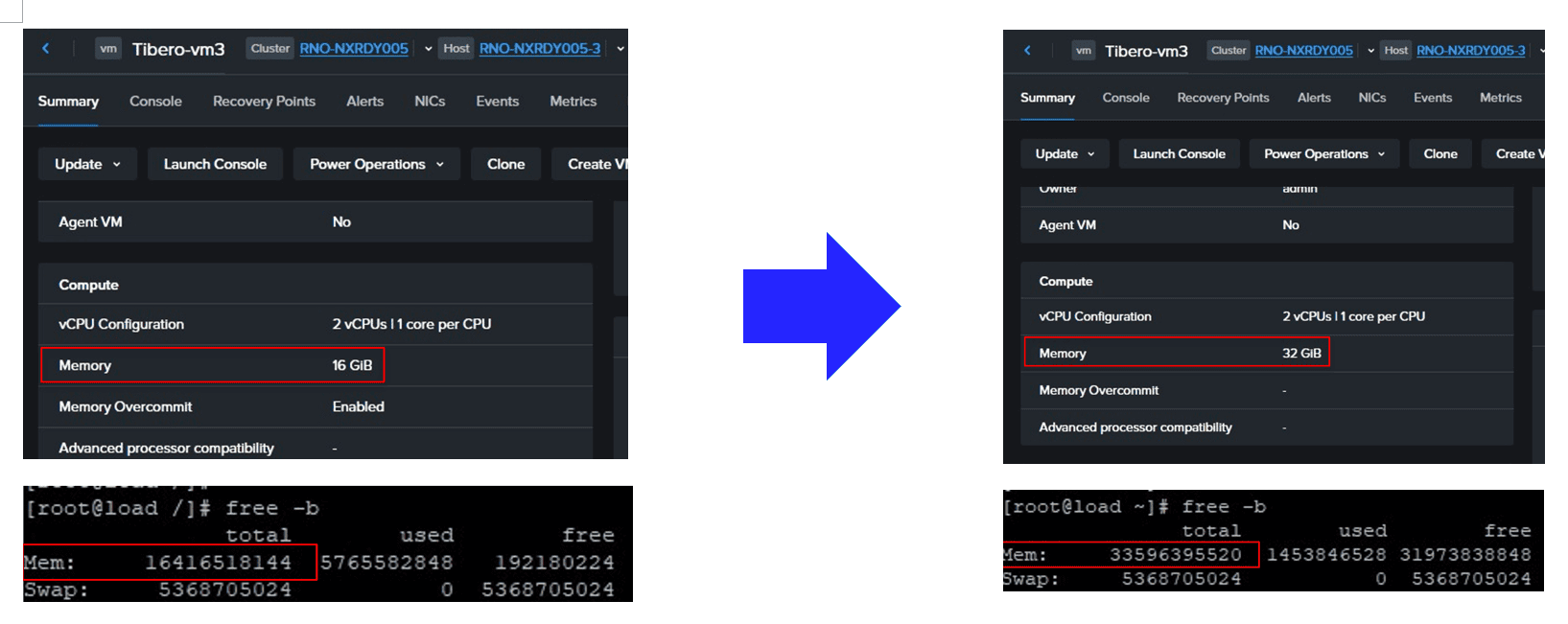
1) Online Memory expansion
The virtual machine memory was increased from 16 GB to 32 GB while Tibero7 continued running.
The operating system successfully recognized the newly allocated memory without requiring a reboot, and the database remained fully operational throughout the operation.
Memory Configuration
- Before: 16 GB
- After: 32 GB
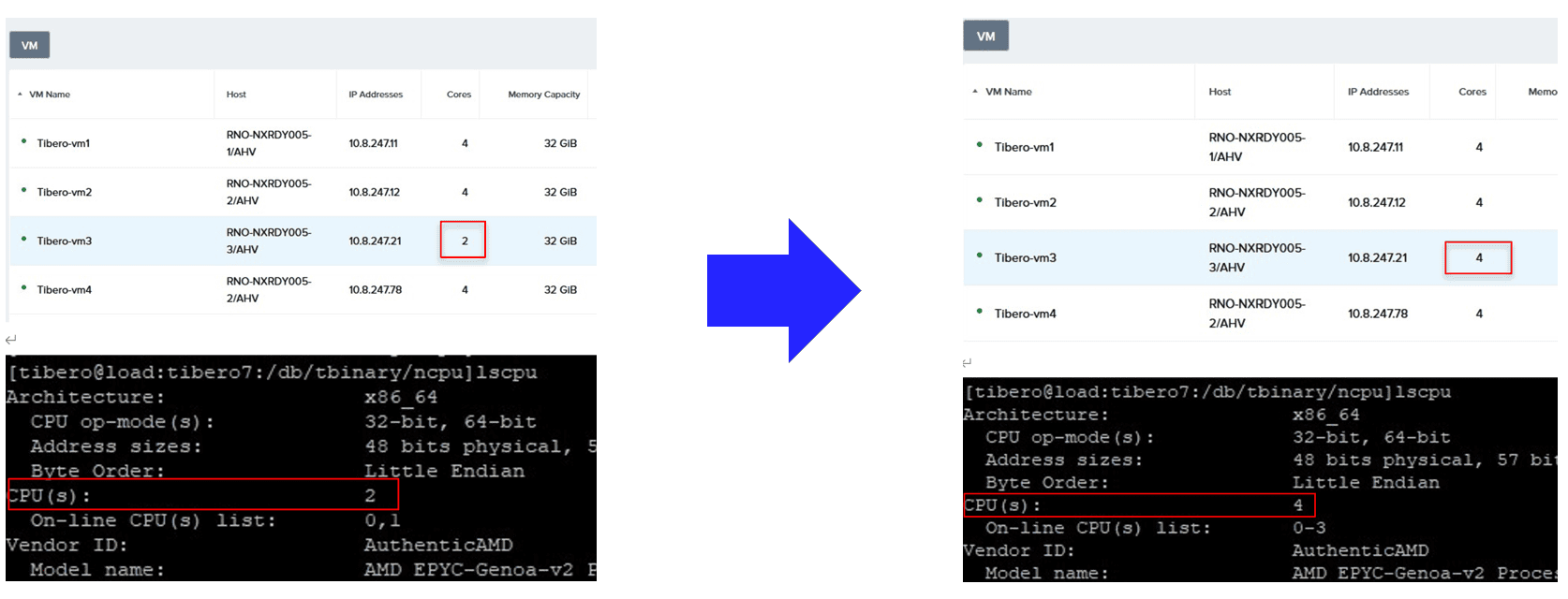
2) Online vCPU expansion
The number of virtual CPUs assigned to the virtual machine was increased from 2 vCPUs to 4 vCPUs during runtime.
The additional CPU resources were successfully recognized, allowing the database to continue processing workloads without interruption.
CPU Configuration
- Before: 2 vCPUs
- After: 4 vCPUs
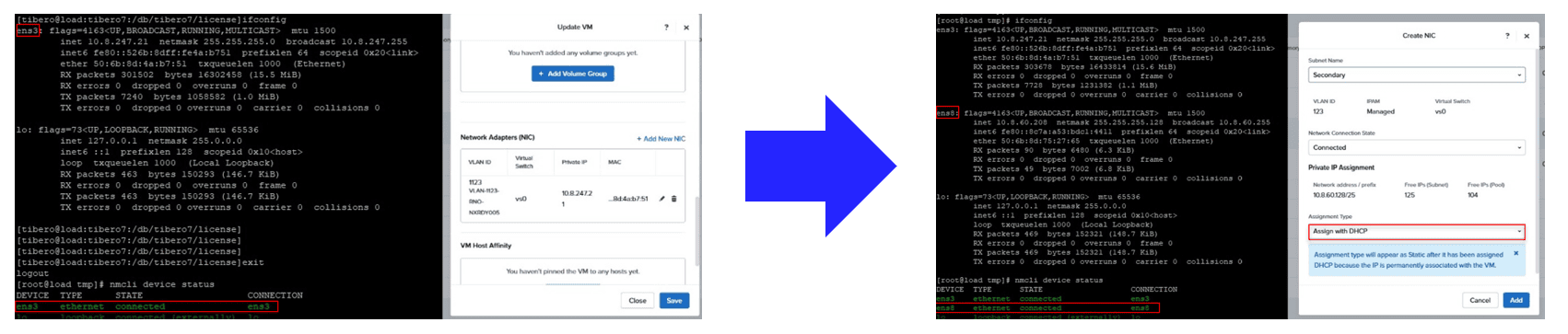
3) Online NIC addition
An additional secondary subnet was attached to the virtual machine while it remained online.
After manually enabling the newly added network interface within the guest operating system, Tibero continued operating normally.
4) Online Disk addition
A new 50 GB virtual disk was added to the running virtual machine.
The operating system detected the additional storage device successfully, enabling it to be used without interrupting database operations.
Storage Configuration
• Additional Disk: 50 GB (sdb)

Validation Summary
These tests demonstrate that Tibero7 continues operating normally while compute, memory, networking, and storage resources are expanded dynamically.
This capability enables infrastructure administrators to scale virtual machine resources with minimal operational impact, improving infrastructure flexibility while maintaining database availability.
9.2 Virtual Machine Migration Between Nutanix Clusters
Another validation scenario involved migrating a running virtual machine between different Nutanix clusters.
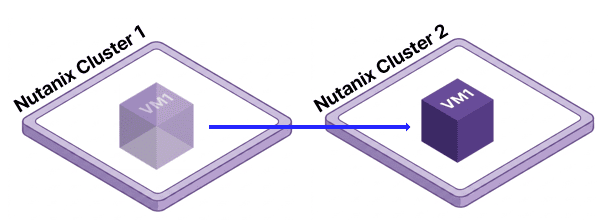
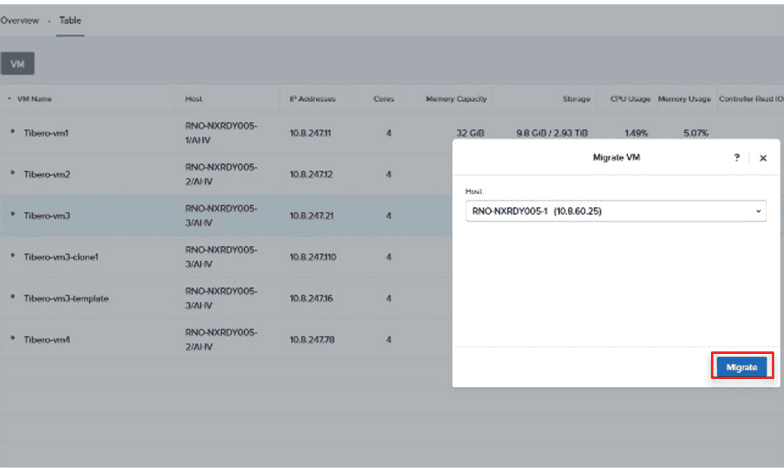
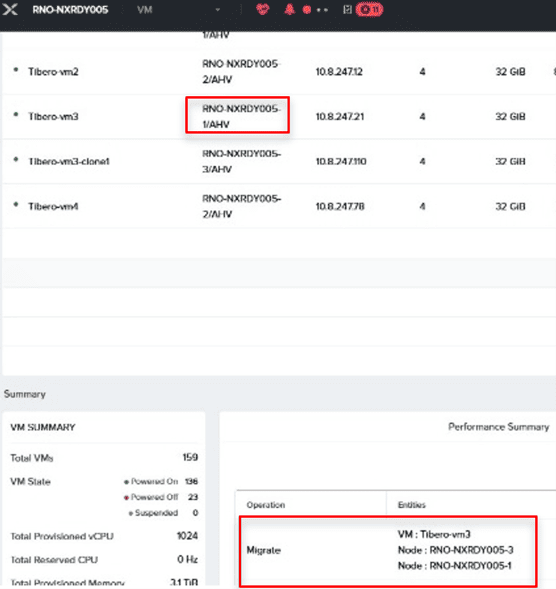
During this validation, the virtual machine was successfully migrated from Cluster RNO-NXRDY005-3 to Cluster RNO-NXRDY005-1.
Cluster migration is commonly performed when infrastructure policies change, workloads are redistributed, or capacity balancing is required across multiple Nutanix clusters.
Throughout the migration process, Tibero7 continued operating as expected, demonstrating compatibility with Nutanix AHV’s virtual machine mobility capabilities.
This result confirms that database workloads can be relocated between Nutanix clusters without requiring application-level reconfiguration.
9.3 Nutanix VM Cloning
The validation also included cloning a Tibero virtual machine.
Before powering on the cloned virtual machine, a new IP address was assigned to prevent network conflicts with the original VM.

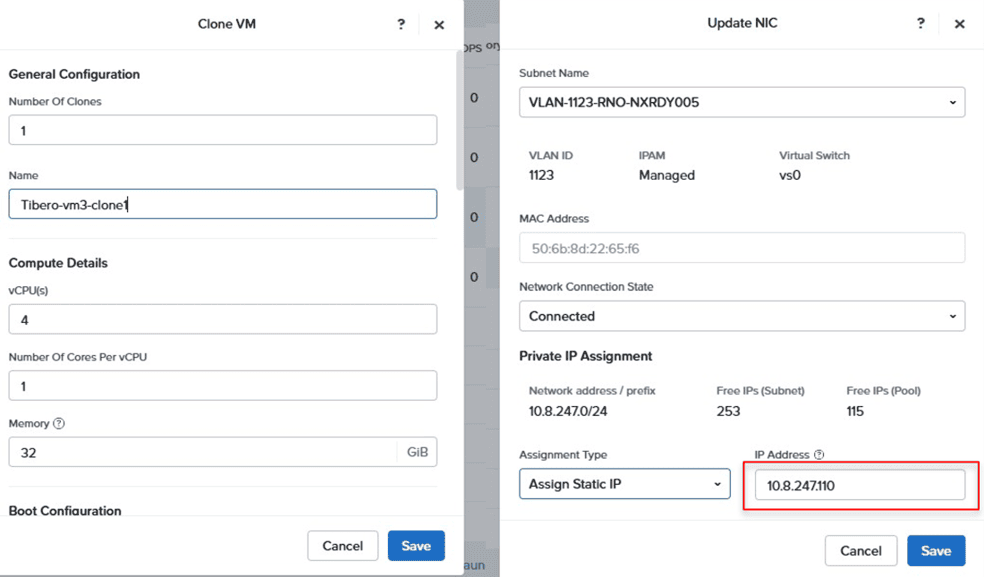
This capability simplifies the creation of development, testing, and staging environments based on existing production configurations.
9.4 Nutanix VM Snapshot
The final validation scenario verified the VM Snapshot functionality provided by Nutanix AHV.
Snapshots allow administrators to capture the state of a virtual machine at a specific point in time, making them valuable for maintenance operations, testing, and recovery scenarios.
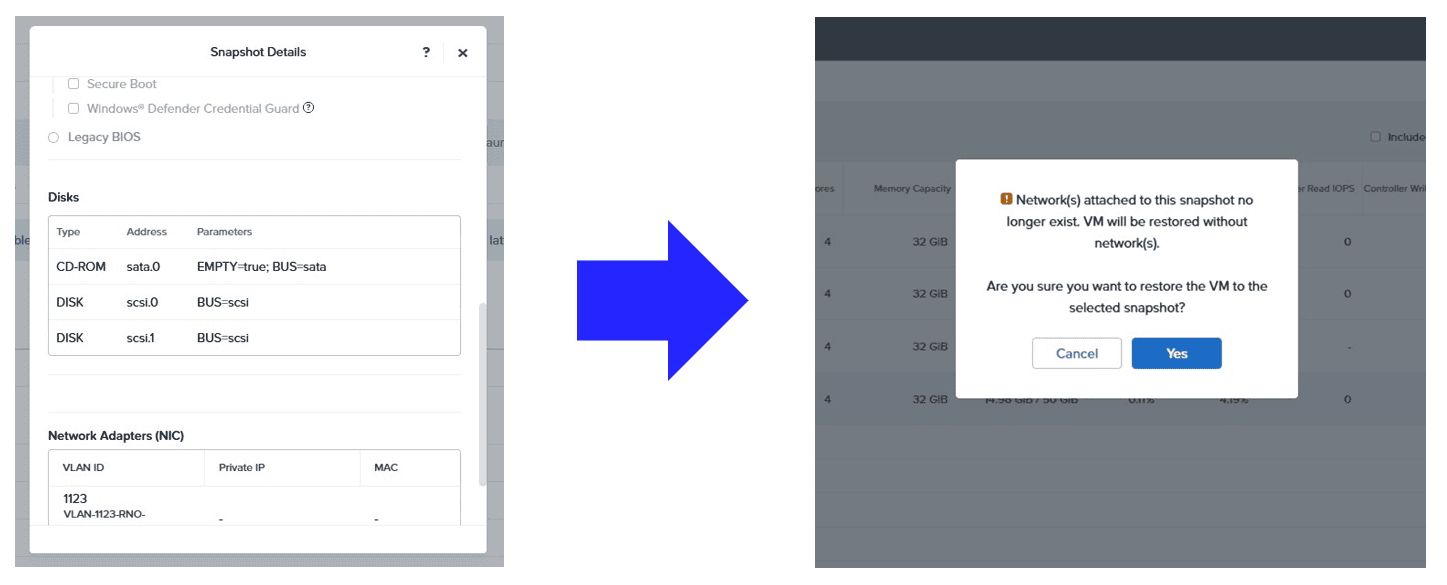
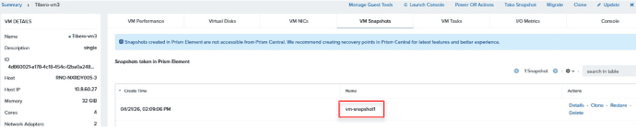
This result demonstrates that Tibero7 is compatible with Nutanix AHV snapshot functionality, providing administrators with additional operational flexibility for backup and recovery workflows.
10. Listing in the Nutanix Compatibility & Interoperability Matrix
Following the successful completion of the validation, Tibero DB 7 was officially listed in the Nutanix Compatibility & Interoperability Matrix
(Source : Nutanix Compatibility & Interoperability Matrix)
This listing confirms that Tibero DB 7 has been validated for operation with Nutanix AOS 7.5 and AHV 11.0, providing customers with an authoritative reference when evaluating Tibero7 for deployment on Nutanix AHV-based infrastructures.
Organizations planning to adopt Tibero7 on Nutanix can use the Compatibility & Interoperability Matrix as a trusted source for verifying platform compatibility during infrastructure planning and solution design.
It is important to note, however, that inclusion in the Nutanix Compatibility & Interoperability Matrix does not guarantee optimal performance or configuration for every deployment scenario.
Actual production environments vary in terms of hardware specifications, virtual machine sizing, operating system configurations, storage policies, network architecture, and workload characteristics.
For production deployments, organizations should therefore conduct comprehensive performance benchmarking, workload validation, and failover testing in addition to confirming platform compatibility.
11. Validation Results and Key Takeaways
The validation produced two significant findings.
1) Tibero7 Deployment Remains Consistent on Nutanix AHV
The first key finding is that installing and operating Tibero7 on Nutanix AHV closely mirrors the experience of deploying Tibero on a conventional Linux virtual machine.
Virtual machines running on AHV are managed in much the same way as standard Linux servers, allowing administrators to install and operate Tibero without requiring Nutanix-specific deployment procedures or configuration changes.
Throughout the validation, no platform-specific limitations or installation constraints unique to Nutanix AHV were identified.
This consistency helps reduce the learning curve for administrators while simplifying migration from existing virtualized environments.
2) TAC Requirements Are Fully Supported on Nutanix
The second key finding is that the infrastructure requirements for Tibero Active Cluster (TAC) can be fully implemented within a Nutanix AHV environment.
Shared storage for Tibero Active Storage (TAS) was successfully provided through Nutanix Volume Groups configured in Shared Mode.
In addition, separate public and interconnect networks were configured to support reliable node-to-node communication within the cluster.
Together, these capabilities demonstrate that Nutanix AHV can provide the storage and networking architecture required for enterprise-grade clustered database deployments.
Expanding Infrastructure Choices for Enterprise Databases
Historically, enterprise virtualized database environments have been built predominantly on VMware-based infrastructure.
This validation demonstrates that Nutanix AHV-based HCI is also a viable platform for deploying and operating Tibero7, providing organizations with greater flexibility when evaluating infrastructure options for new deployments or virtualization platform migrations.
Rather than limiting database workloads to a single virtualization ecosystem, organizations can now consider Nutanix AHV as an alternative platform capable of supporting enterprise database operations with high availability and operational reliability.
Conclusion
Enterprise infrastructure continues to evolve—from traditional bare-metal servers and dedicated storage architectures to virtualized, hyperconverged, and hybrid cloud environments.
As infrastructure evolves, enterprise database platforms must also provide consistent deployment and operational experiences across increasingly diverse environments.
Throughout this three-part series, we demonstrated how Tibero7 was deployed and validated on a Nutanix AHV-based HCI platform.
The validation covered the complete deployment lifecycle, including:
- Infrastructure architecture
- Virtual machine provisioning
- Shared storage configuration
- Tibero Active Cluster (TAC) deployment
- Operational validation under real-world virtualization scenarios
The successful completion of the Nutanix Ready Validation confirms that Tibero7 can operate reliably within modern HCI environments while integrating seamlessly with Nutanix virtualization and storage technologies.
Looking ahead, Tibero will continue expanding its validation efforts across a broad range of on-premises, HCI, and cloud platforms, enabling customers to deploy Tibero in the infrastructure environment that best aligns with their operational and business requirements.




No Comment! Be the first one.