

1. Introduction: Tibero7 on Nutanix
Enterprise IT infrastructure has undergone significant transformation over the years, evolving from traditional bare-metal deployments to virtualized environments, hyperconverged infrastructure (HCI), and, more recently, hybrid cloud architectures. As infrastructure becomes increasingly software-defined, enterprise databases must also adapt by operating reliably across virtualized, HCI, and cloud environments rather than relying on specific hardware platforms.
In this article, we introduce the validation process of deploying Tibero7 on a Nutanix AHV-based HCI environment, covering both Single Instance and TAC (Tibero Active Cluster) configurations.
As a result of this validation, Tibero7 has been officially listed in the Nutanix Compatibility & Interoperability Matrix as TmaxTibero / Tibero DB 7. In addition, Tibero7 successfully completed Nutanix Ready AHV validation on Nutanix AOS 7.5 and AHV 11.0.
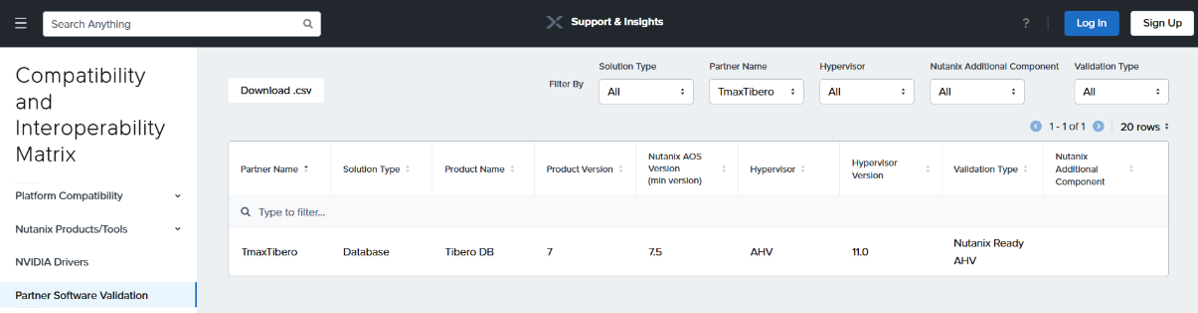
[Figure 2] Tibero7 Listed in the Nutanix Compatibility & Interoperability Matrix (Source: Nutanix Compatibility & Interoperability Matrix)
2. Evolution of Enterprise Infrastructure: From Bare Metal to Hybrid Cloud
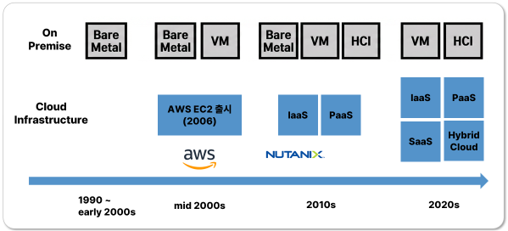
To better understand the significance of validating Tibero7 on Nutanix AHV, it is helpful to first review how enterprise infrastructure has evolved over time.
Historically, enterprise systems were primarily deployed on physical servers, where a single operating system was installed directly on the hardware, and applications and databases ran natively on that server.
This deployment model is commonly referred to as a bare-metal environment. Bare-metal architectures offer predictable performance and a relatively simple system design. However, they provide limited flexibility in resource allocation, making infrastructure scaling and operational automation more challenging.
In addition, enterprise environments traditionally relied on proprietary UNIX operating systems such as AIX and Solaris, resulting in tight coupling between hardware platforms and operating systems.
As industry adoption of x86 servers and Linux accelerated, enterprise infrastructure became significantly more flexible. This shift also paved the way for widespread adoption of server virtualization.
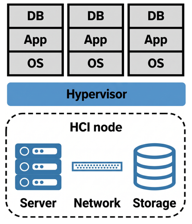
In a virtual machine (VM) environment, a hypervisor runs on top of the physical server, allowing multiple virtual machines to operate independently, each with its own operating system and applications.
Well-known hypervisors include VMware ESXi and Microsoft Hyper-V.

Virtualization dramatically improved infrastructure utilization while simplifying application deployment and system management. However, compute, storage, and networking often remained separate infrastructure domains, introducing operational complexity when expanding or managing enterprise environments.
To address these challenges, the industry introduced Hyperconverged Infrastructure (HCI).
HCI consolidates compute, storage, and networking into a software-defined platform, enabling all infrastructure resources to be managed as a unified cluster.
Rather than configuring individual hardware components, administrators manage virtual machines, storage, and networking from a centralized management interface, greatly simplifying infrastructure operations.
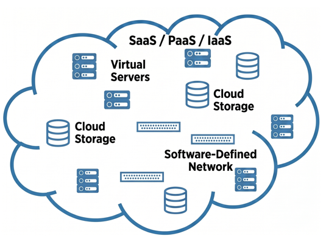
Today, enterprise IT strategies increasingly embrace hybrid cloud architectures instead of maintaining completely separate on-premises and public cloud environments.
Many organizations continue to operate mission-critical or regulatory-sensitive workloads on-premises while leveraging public cloud services for applications requiring greater scalability and operational agility.
Within this architecture, HCI serves as the foundational technology that enables on-premises infrastructure to deliver a cloud-like operational experience.
Databases are no exception to this evolution.
Modern database management systems (DBMSs) are expected to operate consistently across physical servers, virtualized environments, HCI platforms, and cloud infrastructures without being tied to specific hardware configurations.
The validation of Tibero7 on Nutanix AHV was conducted in response to this industry trend, demonstrating that Tibero can be reliably deployed and operated within modern HCI environments.
3. What Is Hyperconverged Infrastructure (HCI)?
Hyperconverged Infrastructure (HCI) is an infrastructure architecture that integrates compute, storage, and networking into a single software-defined platform.
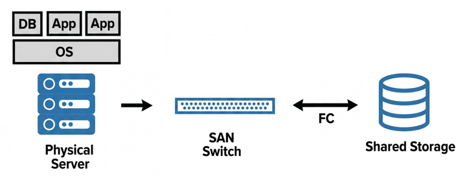
In traditional three-tier architectures, servers, SAN storage, and networking devices are deployed and managed as separate infrastructure layers. Each component typically requires its own management tools, operational procedures, and administrative expertise.
By contrast, HCI consolidates these resources into a cluster of nodes, where each node contributes both compute and storage resources. Collectively, the cluster functions as a unified resource pool that can be centrally managed.
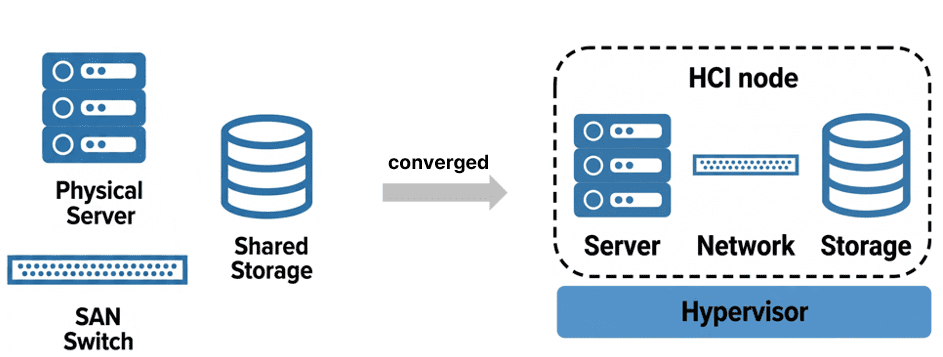
In conventional enterprise infrastructures, scaling server capacity, expanding storage, or modifying network configurations often involves separate administrative domains. As a result, infrastructure expansion and incident response typically require coordination across multiple teams, increasing operational complexity.
HCI addresses these challenges by abstracting infrastructure resources through software.
Multiple physical servers are combined into a cluster, while each node’s local storage is aggregated into a software-defined storage (SDS) layer. Rather than managing individual servers or disks directly, administrators provision virtual machines and applications using logical resources provided by the cluster.
This architecture simplifies infrastructure management while enabling greater operational flexibility and scalability.
Key Benefits of HCI
1. Simplified Infrastructure Management
Because virtual machines, storage, and networking are managed through a unified management console, administrative overhead is significantly reduced.
Instead of operating multiple management systems for different infrastructure components, administrators can monitor and manage the entire environment from a single interface.
2. Linear Scale-Out Architecture
When additional capacity is required, organizations simply add new nodes to the cluster.
Each node contributes both compute and storage resources, allowing the infrastructure to scale horizontally without requiring major architectural changes.
This scale-out model enables organizations to start with a relatively small deployment and expand incrementally as business requirements grow.
3. Optimized for Virtualized Workloads
Although HCI provides significant operational advantages, running stateful workloads such as databases requires careful architectural planning.
Unlike stateless application workloads, databases place stringent requirements on storage performance, network reliability, and high availability.
Several factors should therefore be evaluated before deploying a DBMS on an HCI platform, including:
- Storage architecture and I/O performance
- Network isolation and communication latency
- High availability (HA) design
- Shared storage requirements
- Failure recovery scenarios
- Vendor compatibility and certification
For clustered database environments, reliable node-to-node communication and shared storage configurations are often essential to ensure service continuity.
Tibero7 Validation on Nutanix HCI
With these considerations in mind, this validation project focused on verifying whether Tibero7 could be reliably deployed on a Nutanix AHV-based HCI environment.
The scope of validation extended beyond a standard Single Instance deployment to include TAC (Tibero Active Cluster), ensuring that Tibero supports enterprise-grade high availability within a Nutanix HCI infrastructure.
The following sections introduce the core components of the Nutanix platform and explain how Tibero7 was validated in this environment.
4. Introducing the Nutanix Platform: AHV, AOS, and Prism
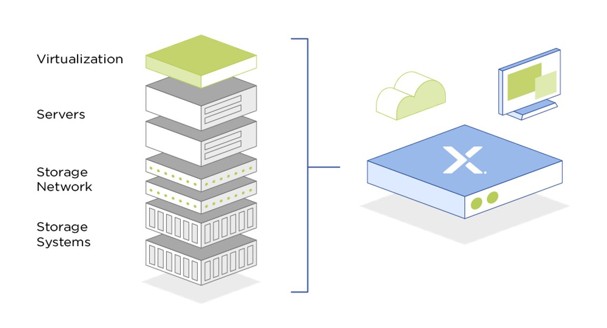
Nutanix is one of the leading platforms in the Hyperconverged Infrastructure (HCI) market.
Initially recognized for replacing traditional SAN-based infrastructure with a software-defined HCI platform, Nutanix has since evolved into a comprehensive cloud platform encompassing virtualization, storage, cloud operations, data services, Kubernetes, and AI infrastructure.
To better understand the validation environment for Tibero7, it is important to become familiar with several core components of the Nutanix platform.
4.1 AHV
AHV (Acropolis Hypervisor) is Nutanix’s native enterprise hypervisor.
Built on the open-source KVM (Kernel-based Virtual Machine) hypervisor, AHV is tightly integrated with the Nutanix platform and optimized specifically for HCI deployments.
Unlike traditional virtualization environments that require third-party hypervisors, AHV enables organizations to provision and manage virtual machines directly within the Nutanix ecosystem.
Working in conjunction with Nutanix AOS, AHV provides core virtualization capabilities, including:
- Virtual machine lifecycle management
- Virtual networking
- Storage integration
- High availability (HA)
- Live migration and infrastructure resiliency
During this validation, Tibero7 was installed and tested on Linux virtual machines running on AHV.
4.2 AOS
AOS (Acropolis Operating System) is the software foundation of the Nutanix platform.
It provides the distributed services that power the Nutanix cluster, including:
- Distributed storage
- Cluster management
- Data protection
- Storage services for virtual machines
In conventional enterprise environments, storage is typically provided by dedicated SAN or NAS systems.
Nutanix takes a different approach by aggregating the local storage resources of every node into a distributed storage fabric, presenting them as a single logical storage pool to the cluster.
This software-defined architecture eliminates the need for external storage arrays while simplifying storage management and improving scalability.
Administrators can provision virtual machine disks and shared storage using logical constructs such as Storage Containers and Volume Groups.
These abstractions allow storage resources to be allocated flexibly without requiring administrators to manage physical disks directly.

4.3 Prism Element and Prism Central
Nutanix provides two complementary management interfaces:
- Prism Element
- Prism Central
Each serves a different operational purpose.
Prism Element
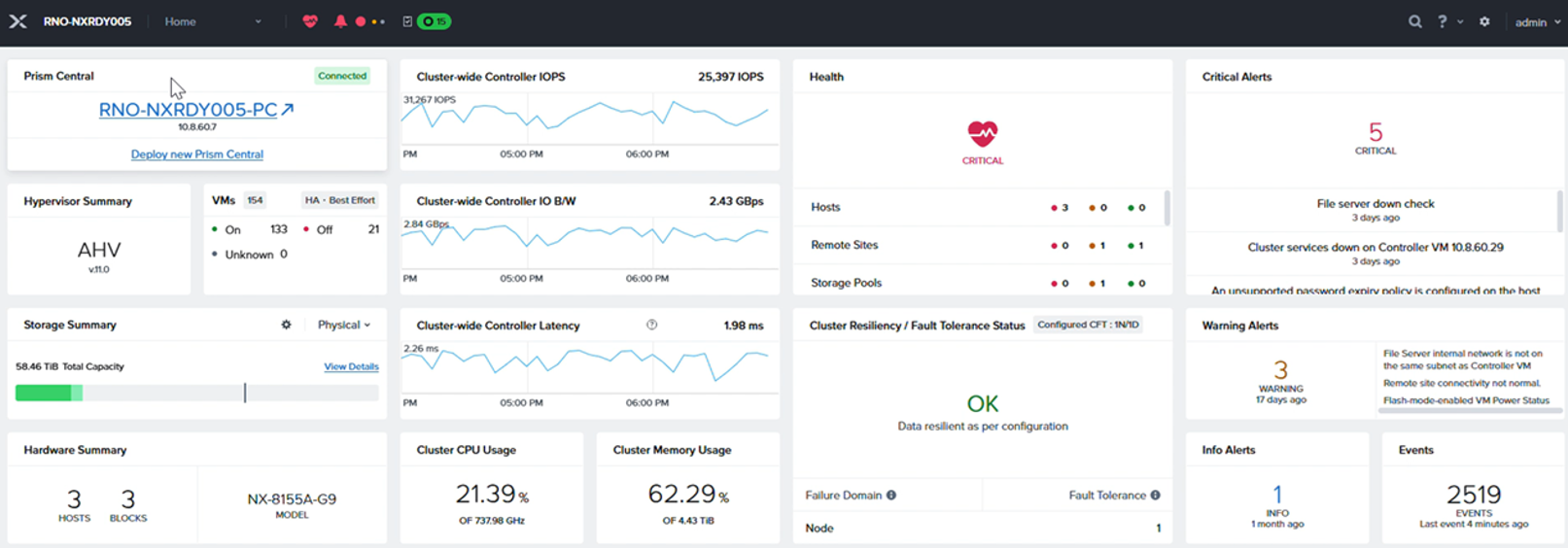
Prism Element is designed to manage an individual Nutanix cluster.
It provides administrators with visibility into the operational status of virtual machines, storage, networking, and overall cluster health.
Typical administrative tasks performed through Prism Element include:
- Launching VM consoles
- Managing virtual network interfaces (NICs)
- Attaching Volume Groups
- Monitoring cluster performance
- Managing storage resources
Because it operates at the cluster level, Prism Element is primarily used for day-to-day infrastructure administration.
Prism Central
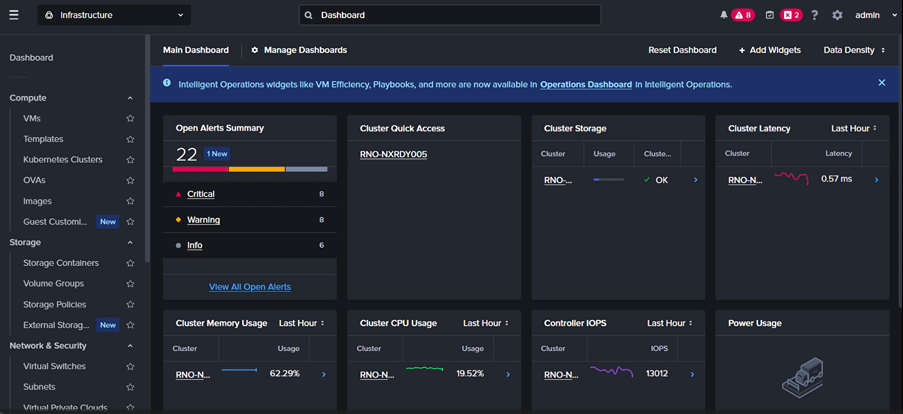
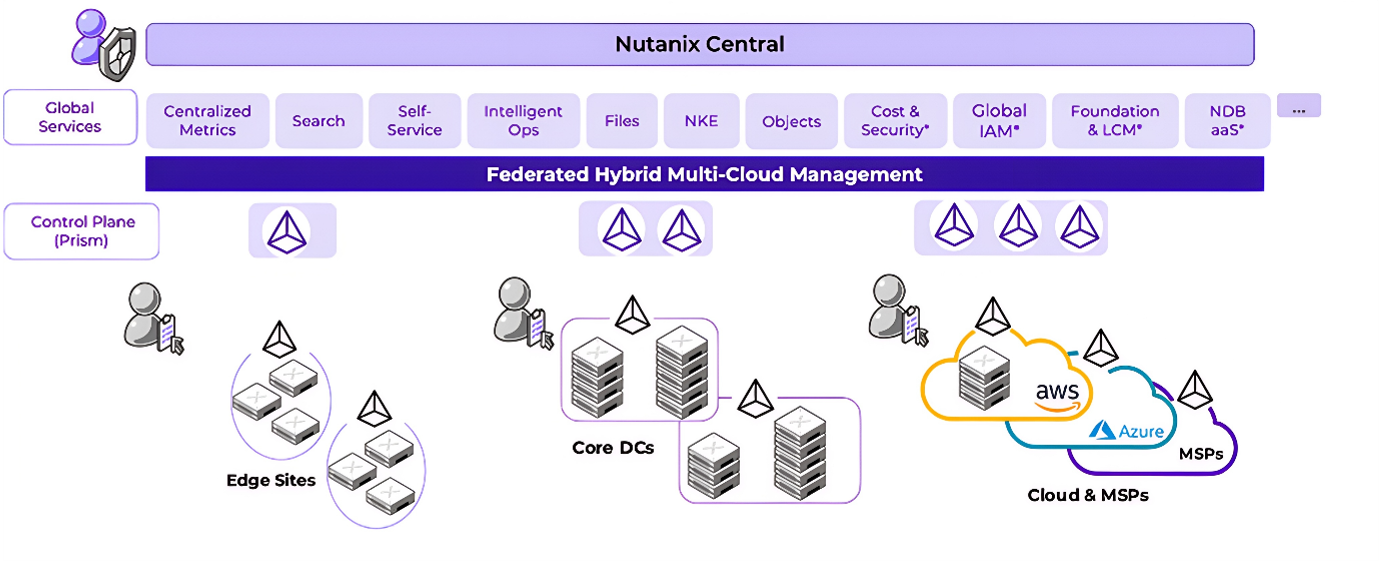
Prism Central provides centralized management across multiple Nutanix clusters.
Rather than managing clusters individually, administrators can monitor and operate their entire Nutanix environment through a single interface.
Prism Central offers centralized visibility into:
- Virtual machine inventory
- Resource utilization
- Infrastructure policies
- Capacity planning
- Operational health across clusters
This centralized management model is especially valuable in hybrid cloud and multi-cluster environments, where operational consistency and unified governance become increasingly important.
Validation Environment
For this validation project, both Prism Central and Prism Element were used.
Their respective responsibilities were divided as follows:
| Component | Purpose |
| Prism Central | Virtual machine provisioning and overall resource monitoring |
| Prism Element | VM console access, network configuration, and storage attachment |
This combination allowed both centralized infrastructure management and cluster-level operational control throughout the validation process.
4.4 Nutanix Product Portfolio
Beyond AHV and AOS, Nutanix offers a broad portfolio of software solutions that extend its HCI platform into cloud infrastructure and enterprise services.
Key offerings include:
Nutanix Cloud Infrastructure (NCI)
Provides the core HCI platform by integrating virtualization, distributed storage, and networking into a unified software-defined infrastructure.
Nutanix Cloud Manager (NCM)
Delivers centralized cloud management capabilities, including:
- Infrastructure monitoring
- Cost optimization
- Automation
- Governance
- Self-service provisioning
Nutanix Unified Storage (NUS)
Provides enterprise storage services supporting:
- File storage
- Object storage
- Volume services
through a unified storage platform.
Nutanix Database Service (NDB)
Automates database lifecycle management by simplifying tasks such as:
- Database provisioning
- Backup and recovery
- Patch management
- Cloning
- Database automation
Nutanix Cloud Clusters (NC2)
Enables organizations to extend on-premises Nutanix environments into public cloud platforms while maintaining a consistent operational experience.
NC2 plays a key role in hybrid cloud deployments by providing seamless workload mobility between on-premises infrastructure and public cloud environments.
Nutanix Kubernetes Platform (NKP)
Supports enterprise Kubernetes deployments by providing an integrated platform for container orchestration, application modernization, and cloud-native operations.
Looking Ahead
In this article, we introduced the evolution of enterprise infrastructure, the fundamentals of Hyperconverged Infrastructure (HCI), and the key components of the Nutanix platform that formed the foundation of our validation environment.
In the next article, we will walk through the process of deploying Tibero Active Cluster (TAC) on a Nutanix HCI environment, covering the architecture, deployment procedures, and configuration details used to validate enterprise-grade high availability.





No Comment! Be the first one.